Introduction
Obstructive Sleep Apnea (OSA) is a widespread yet chronically underdiagnosed condition affecting millions globally. An estimated 80% of sufferers remain undiagnosed and untreated — not only because the condition frequently goes undetected, but because patients themselves tend to dismiss poor sleep as an unavoidable fact of life rather than a clinical concern worth pursuing.
Traditionally identified through formal sleep studies, OSA is deeply rooted in craniofacial anatomy and airway structure – placing dentistry in a uniquely powerful position for early detection.
Today, artificial intelligence in dentistry is transforming how clinicians identify, analyze, and manage sleep apnea risk. With advanced imaging and AI-powered tools like CephX, dental professionals can now detect anatomical risk factors earlier and more accurately.
Why Sleep Apnea Matters in Dentistry
Sleep apnea occurs when the airway collapses during sleep, leading to interrupted breathing. While symptoms such as snoring and fatigue are well known, the underlying causes are often anatomical.
Dentists and orthodontists are uniquely positioned to identify these risk factors through routine imaging, including:
- CBCT scans
- Cephalometric X-rays
Common anatomical indicators of OSA include:
- Mandibular retrognathia (recessed lower jaw)
- Reduced airway space
- Enlarged soft palate
- Inferiorly positioned hyoid bone
- Tongue size and positioning
These features can be analyzed directly from dental imaging, making dentistry a key entry point for sleep apnea screening and early detection.
The Role of AI in Sleep Apnea Detection
The introduction of AI in dental imaging is shifting diagnostics from manual interpretation to data-driven analysis.
AI can:
- Automatically identify anatomical landmarks
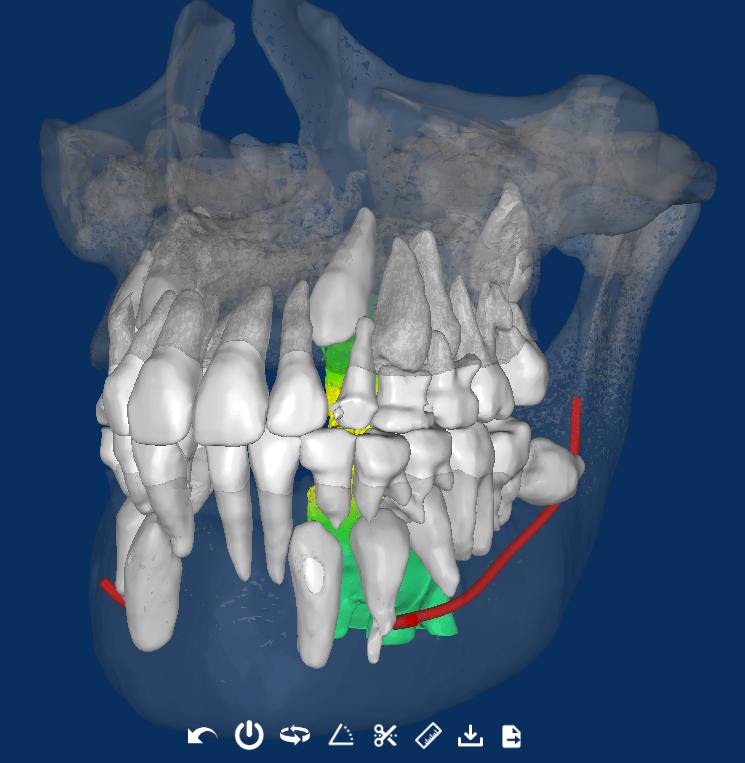
- Quantify airway dimensions
- Detect patterns associated with airway obstruction
- Standardize diagnostic flags across clinicians
- Provide convincing and clear visual evidence to the patient in order for them to adopt relevant treatment and primarily further testing
This enables faster, more consistent, and more accurate identification of patients at risk for OSA.
Cephalometric Analysis and Airway Evaluation
Cephalometric analysis has long been used to evaluate craniofacial structure and airway relationships. In patients with sleep apnea, studies consistently show:
- Reduced posterior airway space
- Inferior displacement of the hyoid bone
- Enlarged or elongated soft palate
- Skeletal discrepancies such as mandibular retrognathia
By quantifying these structures, clinicians can assess airway restriction and anatomical predisposition to OSA, supporting earlier and convincing evidence of such possible conditions .
How CephX Enhances AI-Driven Sleep Apnea Analysis
CephX brings AI directly into orthodontic and dental workflows, transforming imaging into structured clinical insight.
1. Airway Volume Analysis
CephX automatically calculates:
- Total airway volume
- Minimal cross-sectional area
- On AP measurements
- On LR measurements
- On total area measurements
Using 3D CBCT data, clinicians gain objective measurements that are essential for evaluating airway restriction and OSA risk.
2. Automated Cephalometric Tracing
CephX generates complete cephalometric analyses within seconds, identifying key anatomical features such as:
- Soft palate size and morphology
- Hyoid bone location
- AP airway measurements
This reduces manual work and ensures consistent, reproducible results.
Benefits for Clinicians and Patients
Integrating AI-powered tools like CephX into dental workflows provides several advantages:
For Clinicians:
- Faster and more accurate diagnostics
- Standardized analysis across cases
- Improved collaboration with sleep specialists and providers
For Patients:
- Earlier identification of sleep apnea risk
- Clear, visual understanding of their condition
- Convincing evidence for patients to perform sleep a study (polysomnography)
The Future of AI in Dental Sleep Medicine
As AI continues to evolve, dentistry is becoming a frontline discipline in sleep health.
The next phase of innovation will focus on:
- Connecting imaging, diagnosis, and treatment planning
- Reducing workflow inefficiencies
- Enabling predictive and preventive care
Platforms like CephX are helping lead this shift by transforming imaging into actionable clinical intelligence.
Conclusion
Sleep apnea is not just a sleep disorder. It is a condition deeply connected to airway anatomy and craniofacial structure.
With AI-powered tools like CephX, dental professionals can:
- Detect risk factors earlier
- Improve diagnostic accuracy
- Enhance patient communication
- Support better clinical outcomes
AI is not only improving dental diagnostics. It is redefining the role of dentistry in whole-body health.